Braided and spiral hydraulic hose are the two reinforcement architectures used in every high-pressure hydraulic system. They look similar from the outside, share the same rubber compounds, and often appear in the same catalog - but their construction, pressure capacity, flexibility and impulse life are fundamentally different. Specifying the wrong type causes premature failure, unnecessary cost, or both. This article compares them technically so buyers can specify correctly.
1. Construction: How Reinforcement Wire is Applied
The difference is in how the high-tensile steel wire reinforcement is applied to the hose.
Braided hose (1SN, 2SN, SAE 100R1, SAE 100R2): Wire is woven in a basket-weave pattern over the inner tube. Each wire crosses over and under the adjacent wires, forming a flexible braid. 1SN has one layer of braid; 2SN has two layers.
Spiral hose (4SP, 4SH, SAE 100R12, SAE 100R13): Wire is wound in alternating spiral layers around the inner tube. Each layer runs parallel - the wires do not cross. 4SP and 4SH have four layers; R13 has four layers; R15 has six layers for ultra-high pressure.
The crossover pattern of braid makes the reinforcement more flexible but limits pressure capacity. The parallel lay of spiral handles higher pressure but is stiffer.
2. Pressure Capacity
Spiral hose handles higher pressure than braided hose at every size. At 1/2" ID:
- 1SN (single braid): 18 MPa (2,600 psi)
- 2SN (two braid): 28 MPa (4,000 psi)
- 4SP (four spiral): 41 MPa (5,950 psi)
- 4SH (four spiral, heavy): 42 MPa (6,090 psi) at 3/4" (4SH is not commonly specified at 1/2")
For any application above 28 MPa (4,000 psi), spiral hose is the correct specification. Below 28 MPa, braided hose is usually adequate and offers better flexibility.
3. Flexibility and Bend Radius
Braided hose is more flexible than spiral hose. The crossover weave allows the reinforcement to bend without stressing individual wires. Spiral hose is stiffer because the parallel wires resist bending.
At 1/2" ID, typical minimum bend radius:
- 1SN: 75mm (3")
- 2SN: 90mm (3.5")
- 4SP: 150mm (6")
- 4SH: 180mm (7")
In confined machinery compartments where routing is tight, braided hose may be the better choice even when spiral would meet the static pressure requirement.
4. Impulse Life
Impulse life is the number of pressure cycles a hose can withstand before failure. Tested by cycling between 0 and 133%% of working pressure at elevated temperature per SAE J517 / EN 853.
- Braided hose (1SN, 2SN): ≥ 200,000 cycles
- Spiral hose (4SP, 4SH, R12, R13): ≥ 400,000 cycles
Spiral hose lasts approximately 2× longer under cyclic loading. For high-cyclic applications (excavators, mining shovels, presses), this significantly reduces total cost of ownership despite the higher unit price.
5. Weight and Diameter
Spiral hose is heavier and has a larger outside diameter than braided hose at the same inside diameter. The additional wire and thicker cover add weight. For mobile equipment where weight matters (excavators, aerial platforms), this is a trade-off against pressure and impulse life.
6. Cost
Braided hose is less expensive than spiral hose due to simpler construction and less wire. The price premium for spiral hose is typically 30-50%% depending on size and construction. For static or low-cyclic applications, braided hose is the more economical choice.
7. Application Selection Guide
Specify braided hose (1SN, 2SN) for:
- Medium-pressure hydraulic systems (return lines, drain lines)
- Agricultural equipment (tractors, sprayers, implements)
- Material handling equipment (forklifts, low-pressure lift circuits)
- Industrial hydraulic systems below 20 MPa
- Applications where flexibility is more important than maximum pressure
- Confined routing where bend radius is critical
Specify spiral hose (4SP, 4SH) for:
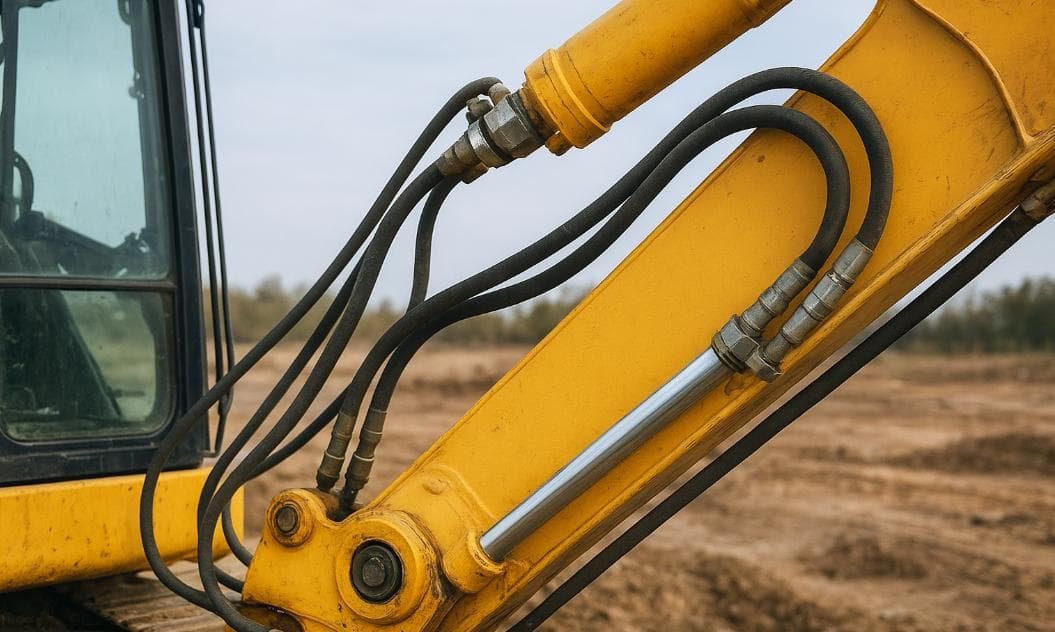
- High-pressure hydraulic systems above 28 MPa (boom, arm, bucket circuits)
- Excavators, loaders, cranes, mobile hydraulics with cyclic duty
- Press machines, hydraulic power units, injection molding
- Mining shovels, drilling rigs, offshore hydraulics
- Any application with high pressure AND cyclic loading
- Applications where long service life justifies higher unit cost
8. Fitting Compatibility
Both braided and spiral hose use standard SAE J516 / DIN EN ISO 12163 reusable and crimp fittings. The fitting field is shared across most hose types. However, the outside diameter differs - the same nominal size fitting crimps to a different diameter on braided vs spiral hose. Always crimp to the fitting manufacturer's published diameter for the exact hose part number.
For 4SP and 4SH, skive-type fittings (where the cover is removed before crimping) are sometimes used. Most modern spiral hose is "non-skive" - the cover is not removed. Confirm the fitting type matches the hose type.
9. Standards Cross Reference
- SAE 100R1AT = EN 853 1SN (one wire braid)
- SAE 100R2AT = EN 853 2SN (two wire braid)
- SAE 100R12 ≈ EN 856 4SP (four spiral, often interchangeable)
- EN 856 4SH has no exact SAE equivalent
- SAE 100R13 = four spiral, heavier than 4SH
- SAE 100R15 = six spiral, ultra-high pressure
The "AT" suffix indicates "non-skive" cover. "S" suffix (1ST, 2ST) indicates skive-type, less common in modern assemblies.
10. Common Specification Mistakes
- Specifying braided hose for high-cyclic high-pressure service: Hose fails in 6-12 months. Specify spiral.
- Specifying spiral hose for low-pressure static service: Unnecessary cost and stiffer routing. Specify braided.
- Substituting 1SN for 2SN: Reduces pressure capacity and may cause failure. The reverse (2SN for 1SN) is mechanically safe.
- Assuming 4SP and SAE 100R12 are identical: They are dimensionally close but not identical standards. For OEM qualification specify the exact standard.
Need Help Choosing?
Send us your system pressure, flow, fluid type, equipment model and duty cycle. Quanyi Rubber engineers will recommend the correct hose construction, fitting combination and assembly specification. Request a quote - typical response within 12 hours with a technical recommendation and quotation.