Specifying the wrong hydraulic hose causes leakage, downtime, equipment damage and safety incidents. This guide walks procurement engineers and OEM buyers through the five technical decisions that define a correct hose specification.
1. Determine the Working Pressure
Hydraulic systems do not run at constant pressure - they cycle and spike. The hose working pressure must exceed the maximum system pressure including spikes, not the nominal rated pressure. A common rule is to specify a hose with at least a 1.25× safety margin over the system relief valve setting.
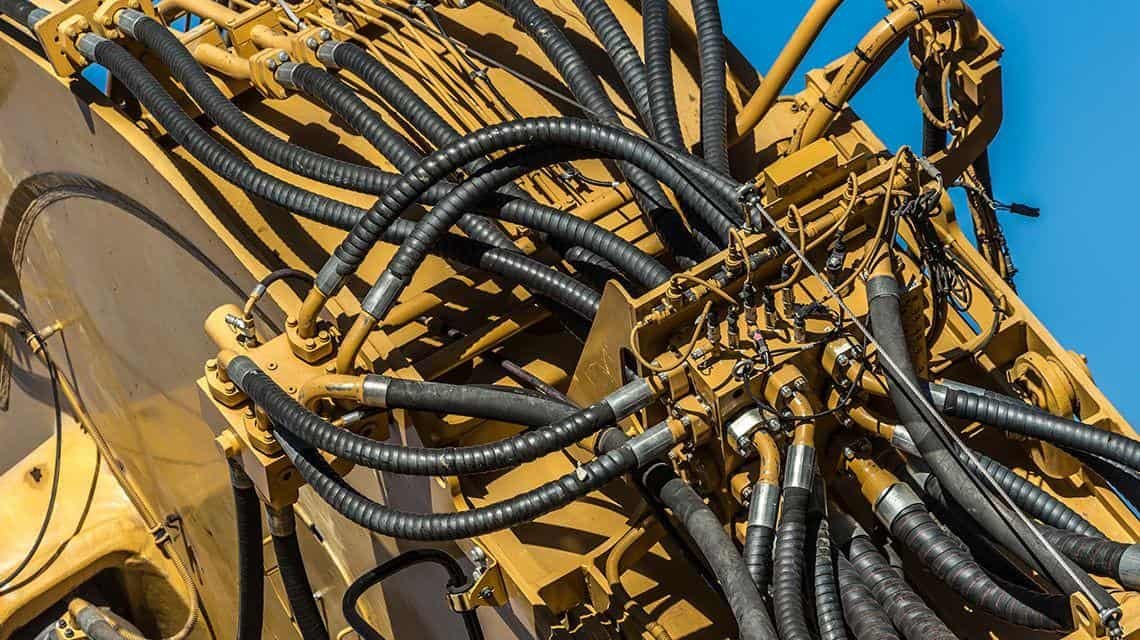
For example, an excavator boom circuit operating at 34 MPa (5,000 psi) with spikes to 41 MPa (6,000 psi) requires a hose rated for at least 41 MPa. SAE 100R2 / EN853 2SN at 1/4" is rated 41 MPa and would be the minimum specification; many OEMs step up to 4SP for additional margin.
2. Calculate the Inside Diameter
Hose ID determines fluid velocity. Excessive velocity causes heat, pressure drop and accelerated wear. Recommended limits:
- Pressure lines: 6 m/s (20 ft/s) maximum
- Return lines: 3 m/s (10 ft/s) maximum
- Suction lines: 1 m/s (3 ft/s) maximum
To calculate required ID: Q (flow in L/min) ÷ 60 ÷ v (velocity in m/s) ÷ 0.7854, then convert to a standard size. Always round up to the next standard ID.
3. Select the Reinforcement Type
Reinforcement determines pressure capacity. The four common constructions are:
- 1SN / SAE 100R1 - one wire braid, medium pressure
- 2SN / SAE 100R2 - two wire braids, high pressure
- 4SP / SAE 100R12 - four spiral wires, very high pressure
- 4SH - four spiral wires, very high pressure at larger IDs
Braid is more flexible; spiral handles higher pressure. For cyclic loading (excavators, mining shovels) specify spiral even when braid would meet the static pressure rating.
4. Match the Inner Tube to the Fluid
Standard NBR (nitrile) works with mineral-oil-based hydraulic fluids. For other media:
- High temperature (above 100°C): HNBR or FKM
- Synthetic / biodegradable fluids: confirm compatibility with the supplier
- Water-based fluids: EPDM
- Phosphate esters: FKM (Viton)
5. Specify the Standard
Always specify BOTH the standard and the size: e.g. "EN853 2SN, 1/2 inch" rather than just "1/2 hydraulic hose". SAE and EN are largely interchangeable for braided hose, but specifying both removes ambiguity for global procurement.
Bonus: Environmental and Compliance Factors
- Temperature range (continuous and extremes)
- Abrasion exposure (specify abrasion-resistant cover)
- UV and ozone exposure (specify EPDM cover or ozone-resistant compound)
- Underground mining (specify MSHA-style flame-resistant cover)
- Food contact (specify FDA-compliant compounds)
Need Help Specifying?
Quanyi Rubber engineers help OEM buyers and distributors translate system requirements into a complete hose specification. Send your system parameters - flow, pressure, fluid, temperature, application - and we will respond within 4 business hours with a recommended hose, fitting and assembly specification.